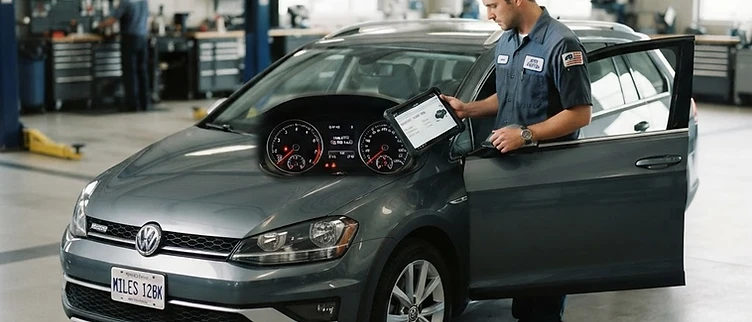
Don't let the odometer make your decision for you. Learn how to weigh mileage, maintenance, and vehicle history when shopping for a used car in Wichita.
Andrew Woods September 5, 2026
There is no single mileage number that automatically makes a used car a bad buy.
A car with:
120,000 miles
can potentially be a better purchase than one with:
70,000 miles.
It depends on:
Maintenance
Vehicle history
Age
Condition
Model
How it was driven
Price
What maintenance is coming next
Mileage matters.
It just shouldn't be the only thing you look at.
Is 100,000 Miles Too Much for a Used Car?
Not automatically.
Modern vehicles can often travel well beyond 100,000 miles when they're properly maintained.
But once you're shopping around that mileage, I'd pay closer attention to:
Maintenance history
Fluids
Suspension
Brakes
Tires
Cooling system
Engine condition
Transmission behavior
Scheduled maintenance
A 100,000-mile vehicle isn't automatically worn out.
But you should understand where it is in its maintenance life.
What About 150,000 Miles?
Again, it depends.
At 150,000 miles, I would expect the price to reflect the mileage and I'd want to understand the vehicle's condition carefully.
A well-maintained vehicle with documented service may still have plenty of usable life.
But the chances of age- and mileage-related repairs naturally become more relevant.
The question becomes:
“Does the condition and price justify the additional risk?”
Is 200,000 Miles Too Much?
For many buyers, a 200,000-mile vehicle is going to be a higher-risk purchase.
That doesn't mean every 200,000-mile car is junk.
Some vehicles reach that mileage and continue running for years.
But at that point, I'd want:
A very good understanding of its history
Realistic expectations about repairs
A price that reflects the mileage
Ideally, a professional inspection
If you need extremely dependable transportation and have no room in your budget for repairs, a very high-mileage vehicle may not be the best fit.
Age and Mileage Need to Be Considered Together
Consider these two vehicles:
Vehicle A
3 years old
90,000 miles
Vehicle B
10 years old
90,000 miles
Same mileage.
Completely different usage.
Vehicle A averaged roughly:
30,000 miles per year.
Vehicle B averaged:
9,000 miles per year.
Neither is automatically better.
The newer vehicle may have accumulated mostly highway miles.
The older vehicle may have much more age-related deterioration.
You need the whole story.
Highway Miles vs. City Miles
Not all miles are identical.
A vehicle driven long distances on the highway may experience different wear than one used for:
Constant short trips
Stop-and-go traffic
Frequent cold starts
Delivery driving
Unfortunately, an odometer doesn't tell you how every mile happened.
That's why condition and maintenance matter.
Maintenance Can Matter More Than Mileage
I'd rather consider a vehicle with:
110,000 miles
that received consistent maintenance than one with:
70,000 miles
that barely saw an oil change.
Ask about:
Oil changes
Transmission service
Coolant
Brakes
Tires
Major scheduled maintenance
Service history isn't always complete, but anything you can learn helps.
Look at Miles Per Year
One useful number is annual mileage.
For example:
A 5-year-old vehicle with:
60,000 miles
averaged about:
12,000 miles per year.
A 5-year-old vehicle with:
150,000 miles
averaged about:
30,000 per year.
That doesn't automatically make the second vehicle bad.
It just gives you context.
Higher Mileage Should Usually Affect Price
If two vehicles are otherwise similar:
Same year
Same model
Same trim
Similar condition
but one has substantially more mileage, you'd generally expect the market to price that difference in.
That's where higher-mileage vehicles can become interesting.
You may be able to buy a:
newer or better-equipped vehicle
for less because of the mileage.
The tradeoff is potentially greater repair and maintenance risk.
Don't Buy the Odometer Instead of the Car
This happens all the time.
Buyer sees:
49,000 miles
and immediately assumes it's better than the:
82,000-mile
alternative.
But what if the 49,000-mile vehicle has:
Poor maintenance
Worn tires
Accident history
Interior damage
Mechanical problems
while the 82,000-mile vehicle has been maintained extremely well?
The lower-mileage car isn't automatically the better purchase.
Think About How Much You'll Drive
Suppose you drive:
25,000 miles per year.
Buying a vehicle already at:
130,000 miles
means you could be around:
180,000 miles
in only two years.
Someone who drives:
5,000 miles per year
may view the exact same vehicle differently.
Your driving habits matter.
Think About How Long You Want to Keep It
If you're planning to own the vehicle for:
8 years,
starting mileage matters more than if you only plan to keep it for a few years.
Estimate:
Current mileage + your annual mileage × expected ownership years.
That gives you a rough idea of where the vehicle may be later.
High Mileage Can Affect Financing
Mileage isn't just a mechanical consideration.
Some lenders have restrictions based on:
Vehicle age
Mileage
Loan amount
Loan term
A high-mileage vehicle may not qualify for the same financing terms as a lower-mileage one.
You don't want to find the perfect $15,000 vehicle and then discover that the financing structure doesn't work for it.
High Mileage Can Affect Trade Value Later
If you buy a high-mileage vehicle and drive heavily, it may have very high mileage when you're ready to trade.
That can affect future resale or trade value.
If you tend to replace vehicles frequently, keep that in mind.
When Can a High-Mileage Car Be a Good Buy?
A higher-mileage vehicle may make sense when:
It's priced appropriately
Maintenance has been good
The condition is strong
The model has a solid reputation
You understand upcoming maintenance
You don't mind assuming somewhat more repair risk
It can be a way to get more vehicle for your budget.
When Would I Be More Cautious?
I'd be more cautious when you have:
High mileage + poor maintenance + questionable history + existing mechanical problems + high price.
That's very different from mileage alone.
I'd also be cautious if your budget leaves you absolutely no room for future repairs.
Get a Pre-Purchase Inspection
The higher the mileage, the more valuable an inspection can become.
A qualified mechanic can potentially identify:
Leaks
Suspension wear
Brake issues
Engine problems
Cooling-system concerns
Other upcoming repairs
No inspection predicts the future perfectly.
But it's better information than simply staring at the odometer.
So What's the Maximum Mileage I Should Buy?
I wouldn't give you a universal maximum.
Instead, I'd ask:
What vehicle is it?
How old is it?
How has it been maintained?
What's its condition?
What's the price?
How much will you drive?
How long will you keep it?
Can your budget handle repairs?
Those questions tell me much more than:
“It has 104,000 miles. Is that bad?”
The Bottom Line
How many miles is too many for a used car?
There isn't one magic number.
100,000 miles isn't automatically bad.
150,000 isn't automatically bad.
Even very high mileage doesn't automatically mean a vehicle is finished.
But as mileage increases, you should pay closer attention to:
maintenance, condition, history, price, upcoming repairs, and how long you plan to own it.
Don't buy a used car based only on the odometer.
Buy the whole car.
Looking at a Higher-Mileage Used Car in Wichita?
Send me the listing.
Tell me:
Year
Make/model
Mileage
Price
How many miles you drive each year
I'll help you think through whether the mileage makes sense for what you're trying to do.
This article is for general educational purposes and is not mechanical or purchasing advice. Vehicle longevity varies significantly based on design, maintenance, use, environment, condition, and other factors. No mileage level guarantees future reliability.
Frequently asked
Is 100,000 miles too much for a used car?
Not necessarily. Modern vehicles are reliable well past 100,000 miles if they have been properly maintained.
Does highway driving make a difference?
Yes, highway miles are generally less stressful on a vehicle than stop-and-go city traffic, which leads to more wear and tear.
Why is a pre-purchase inspection important for high-mileage cars?
An inspection helps identify hidden wear or upcoming repairs, giving you a better idea of the true cost of ownership before you commit.
How does mileage affect my financing options?
Some lenders have strict limits on age and mileage for used vehicle loans, which could impact the terms or availability of financing.
AW
Andrew Woods
Car salesperson in Wichita, Kansas. I built this resource to help local buyers make confident decisions.