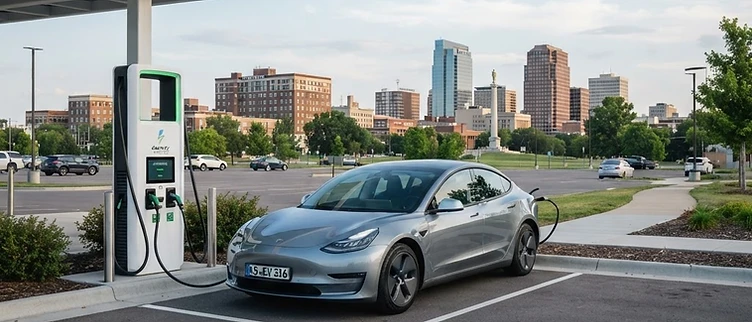
Wondering if an EV is right for your life in Wichita? We break down how local weather, charging access, and real-world costs impact your decision.
Andrew Woods September 15, 2026
Electric vehicles make a lot of sense on paper.
No gas stations. Less routine maintenance. Quiet driving. Instant torque. Plug it in at night and wake up with a charged car.
But does an EV actually make sense if you live in Wichita?
For some Wichita drivers, I'd say absolutely.
For others, I'd probably recommend a hybrid or traditional gas vehicle instead.
The difference has a lot less to do with whether EVs are "good" and a lot more to do with where you live, where you drive, how much you drive and—most importantly—where you're going to charge it.
Quick Answer
An EV can be a great fit in Wichita if you can reliably charge at home and most of your driving happens around the Wichita metro.
I'd be more hesitant if you:
Live somewhere without reliable charging
Regularly take long highway trips
Frequently drive through rural Kansas
Don't want to plan charging stops on road trips
Need to tow significant distances
Are buying an EV primarily because you expect a large federal tax credit
For the right person, Wichita is actually a pretty easy place to own an EV.
Most everyday trips around Wichita aren't particularly long.
If your routine is something like:
Home → work → grocery store → gym → home
you may rarely need a public charger at all.
And that's really the key to understanding EV ownership.
Home Charging Changes the Entire Equation
If you ask me whether you should buy an EV, one of my first questions would be:
Can you charge it at home?
If the answer is yes, I'm much more interested.
If the answer is no, we need to have a longer conversation.
Most EV owners don't need to drive around searching for charging stations every few days. If you have home charging, the normal routine can be much simpler.
You get home.
You plug the car in.
You go inside.
The vehicle charges while you're sleeping.
It's basically like plugging in your phone, except your phone weighs 4,500 pounds.
Level 1 vs. Level 2 Charging
You can generally think of home charging in two categories.
Level 1 charging uses a standard household outlet. It's slow, but depending on how little you drive each day, it may still replace enough range overnight for some owners.
Level 2 charging uses a higher-powered connection and can charge an EV considerably faster.
For many EV owners, Level 2 is the ideal home setup.
Before buying, however, figure out what installation would require at your house.
You may need:
A compatible electrical circuit
An EV charging unit
Professional installation
Potential electrical-panel upgrades
Get an estimate before assuming home charging will cost almost nothing to set up.
What If You Live in an Apartment?
This is where I'd become much more cautious.
If your apartment complex has dependable EV charging, great.
If you can charge at work, that may also solve the problem.
But if your entire ownership plan is:
"I'll just find a public charger whenever I need one,"
I'd think carefully before buying.
Public charging can be useful, especially on trips.
I just wouldn't want my everyday transportation to depend entirely on finding an available public charger unless I understood exactly what that experience would look like.
Home charging is one of the biggest conveniences of EV ownership.
Without it, you're giving up part of what makes an EV attractive in the first place.
Wichita Driving Is Pretty EV-Friendly
Think about how much of your driving actually happens within the Wichita metro.
Maybe you live in Andover and commute into Wichita.
Maybe you're in Derby.
Maybe you're driving between Maize, west Wichita and downtown.
For that kind of normal daily use, a modern EV with adequate range can potentially handle several days of driving between charges depending on the vehicle and your mileage.
And EVs tend to be particularly efficient in city driving because regenerative braking can recover some energy as the vehicle slows down.
That means stop-and-go driving isn't necessarily the efficiency punishment that it is in many gas vehicles.
For a Wichita commuter who charges at home, the day-to-day experience can be extremely convenient.
Kansas Road Trips Are the Bigger Question
Now let's leave Wichita.
This is where your driving habits really matter.
If you regularly drive from Wichita to places like:
Kansas City
Oklahoma City
Tulsa
Salina
Hays
Rural western Kansas
Smaller Kansas communities
you need to think about charging infrastructure along your normal routes.
This doesn't mean you can't road-trip an EV.
You absolutely can.
But the experience isn't identical to driving a gas vehicle.
With a gas vehicle, you usually don't think very hard about fueling. When you're getting low, you find a gas station, spend a few minutes filling up and continue.
With an EV, longer trips may require more planning.
You need to consider:
Where fast chargers are located
Whether they're compatible with your vehicle
Charging speed
How long you need to stop
Your remaining range
Weather
Your destination charging options
If you make one long road trip per year, I wouldn't necessarily let that dictate the vehicle you drive the other 364 days.
If you're crossing Kansas every other weekend, I might.
Wichita Winters Matter
EV range isn't a fixed number.
Weather matters.
Cold temperatures can reduce EV efficiency and range because the battery and cabin both require energy.
That's relevant in Wichita.
We don't experience Minnesota winters, but anyone who lives here knows we can absolutely get stretches of bitter cold, wind, ice and snow.
If your EV normally gives you plenty of extra range for your daily commute, reduced winter efficiency may not matter much.
If you're constantly pushing the limits of the battery, it matters considerably more.
This is why I wouldn't buy an EV based on a range number that barely covers your normal needs.
Give yourself some breathing room.
If your daily driving is 40 miles, you probably don't need to panic because your vehicle's maximum range decreases during a cold snap.
If you're planning a 230-mile highway trip in freezing weather in a vehicle with roughly 250 miles of ideal-condition range, that's a different conversation.
Kansas Summers Matter Too
Then there's the other side of Wichita weather.
It's July.
It's 102 degrees.
The steering wheel is approximately the temperature of the sun.
Climate control uses energy too, so extreme heat can also affect efficiency.
That doesn't mean an EV can't handle a Kansas summer.
It means you should understand that EPA range estimates aren't promises that you'll get exactly that number of miles every time you charge.
Speed, temperature, wind, elevation, HVAC use and driving style can all affect real-world range.
And if you've ever driven west across Kansas into a 30-mph headwind, you already understand that Mother Nature doesn't care what the brochure said.
What About Tornadoes and Power Outages?
This comes up occasionally when people discuss EVs.
"What happens if the power goes out?"
The same thing that happens to every other electrical device at your house: you can't charge it until power returns.
But that doesn't mean the vehicle instantly becomes unusable.
If you have 180 miles of range remaining when the electricity goes out, the battery doesn't suddenly become empty.
It's worth considering if you experience frequent or prolonged outages, but for most people it isn't a reason by itself to rule out an EV.
Gas stations also rely on electricity to operate their pumps.
The better question is whether your overall charging situation is reliable enough for your transportation needs.
Will an EV Save You Money?
Potentially.
But don't assume it automatically will.
EVs can have lower fueling and routine maintenance costs because they don't require things such as:
Engine oil changes
Spark plugs
Engine air filters
Traditional engine maintenance
Many other internal-combustion powertrain services
Regenerative braking may also reduce wear on traditional friction brakes depending on how the vehicle is driven.
But EVs aren't maintenance-free.
They still have:
Tires
Suspension
Cabin air filters
Wipers
Coolant or thermal-management systems depending on the vehicle
Air conditioning
Electronics
Wheel alignments
Other wear items
And tires deserve special attention.
EVs can be relatively heavy and produce a lot of immediate torque. Depending on the vehicle and how you drive, tire wear can become a meaningful ownership expense.
So don't compare:
Gas car = expensive maintenance
against
EV = free forever
That's not reality.
Do the Fuel Savings Actually Make Up for the Price?
This is where I'd run the numbers.
Suppose an EV costs several thousand dollars more than a comparable gas vehicle.
You may spend less on energy every month.
Great.
But how long will it take those savings to recover the difference in purchase price?
If you're saving $80 per month but paid an extra $6,000 for the EV:
$6,000 ÷ $80 = 75 months
That's more than six years.
Obviously, that's only an example. Your actual numbers depend on the vehicles you're comparing, how much you drive, gasoline prices, electricity rates and where you charge.
But that's exactly the point.
Don't buy an EV solely because someone told you it'll save money.
Compare the actual vehicles.
Sometimes the EV wins easily.
Sometimes it doesn't.
And sometimes the EV is worth buying even if it isn't the absolute cheapest option because you simply prefer driving it.
That's allowed too.
Don't Assume There's Still a $7,500 Federal EV Tax Credit
This is especially important in 2026.
You may still see older articles, videos and vehicle listings talking about federal tax credits of up to $7,500 for qualifying new EVs or up to $4,000 for qualifying used EVs.
Those rules changed.
For vehicles acquired after September 30, 2025, the federal New Clean Vehicle Credit and Previously-Owned Clean Vehicle Credit are no longer available.
So if you're shopping for an EV in Wichita today, don't build your purchase around expecting the old federal EV tax credit.
There may still be manufacturer incentives, lease programs, utility programs or other offers depending on the vehicle and timing.
But those should be evaluated separately.
Always verify whatever incentive is actually available when you're shopping.
Kansas Charges More to Register an EV
There's another Kansas-specific cost worth knowing.
Kansas has a higher annual registration fee for electrified vehicles.
The state registration fee is currently:
All-electric vehicle: $165
Hybrid or plug-in hybrid: $70-$100
That's not enough by itself to make or break the decision, but it belongs in the ownership-cost calculation.
EVs don't purchase gasoline, so they don't contribute to road funding through gasoline taxes in the same way traditional vehicles do.
Kansas uses the higher registration fee in part to account for that difference.
What About Battery Replacement?
This is probably the EV version of:
"But what happens when the battery dies?"
Yes, EV batteries can eventually degrade or fail.
And yes, replacing a large battery pack can be expensive.
But that doesn't mean every EV suddenly needs a complete battery at 100,001 miles.
Battery warranties vary by manufacturer, so if you're considering a particular EV, look at the actual battery warranty and degradation terms for that model.
For a used EV, I'd also want to understand the battery's current condition.
That's particularly important because two used EVs with identical mileage may not necessarily have identical usable battery capacity.
Don't just shop the odometer.
Shop the battery too.
Used EVs Can Be Really Interesting
This is an area I'd watch closely as a Wichita shopper.
Some used EVs experience substantial depreciation from their original new-car prices.
That's painful for the original owner.
It can be interesting for the second owner.
A used EV may give you a lot of vehicle for the money if:
The battery is healthy
The remaining range fits your needs
You can charge at home
The vehicle has been properly maintained
You're comfortable with future resale value
The price reflects the used market
The key is not buying it because it "used to cost $50,000."
What it used to cost doesn't matter.
What matters is whether it's worth the price today.
What About Resale Value?
This is another area I'd consider carefully.
EV technology is evolving quickly.
Newer vehicles may offer:
Longer range
Faster charging
Different charging standards
Better battery technology
Improved software
Lower prices
That can affect what older EVs are worth.
If you tend to trade every two or three years, resale value deserves more attention.
If you plan to buy the vehicle and drive it for eight or ten years, short-term depreciation may matter less.
Either way, don't assume an EV will hold its value exactly like the gas vehicle sitting next to it.
Research the specific model.
Would I Buy an EV in Wichita?
If I had reliable home charging and most of my driving happened around Wichita?
Yes, I'd absolutely consider one.
Especially if I had another vehicle available for occasional long trips—or if the EV I was considering had enough range and charging capability that road trips didn't concern me.
I'd be much more hesitant if I lived in an apartment with no charging, frequently drove through rural Kansas or regularly needed to cover long highway distances on a tight schedule.
And if I couldn't charge at home, I'd seriously consider a hybrid instead.
A hybrid can give you substantially better fuel economy without requiring any change to how you fuel the vehicle.
You just drive it and put gas in it.
For some Wichita drivers, that's the better compromise.
Who Should Consider an EV in Wichita?
An EV makes the most sense to me if you:
Have a garage or reliable place to charge at home
Mostly commute within Wichita and surrounding communities
Know roughly how many miles you drive each day
Want lower day-to-day energy costs
Prefer the way EVs drive
Don't mind planning ahead for longer trips
Plan to keep the vehicle long enough to enjoy the ownership benefits
Who Might Be Better Off With a Hybrid or Gas Vehicle?
I'd think twice about an EV if you:
Can't reliably charge at home or work
Frequently drive long distances through rural areas
Tow long distances regularly
Need maximum flexibility with minimal planning
Regularly make unpredictable long-distance trips
Are buying primarily because you think a tax credit makes it cheap
Don't actually save enough money to justify paying substantially more for the vehicle
There is nothing wrong with deciding an EV doesn't fit your life.
There is also nothing wrong with deciding it fits perfectly.
The vehicle should adapt to your lifestyle—not the other way around.
Bottom Line
Yes, buying an EV can absolutely be worth it in Wichita.
For someone who charges at home and mostly drives around the Wichita metro, EV ownership can be incredibly convenient.
Plug in at night.
Wake up with a charged vehicle.
Drive around town.
Repeat.
But Wichita is only part of the equation.
If your life regularly takes you across Kansas, you live somewhere without charging, or you simply don't want to think about charging infrastructure, a hybrid or efficient gas vehicle may fit you better.
And don't buy an EV because you're told you're supposed to want one.
Run the numbers.
Think about your commute.
Think about your road trips.
Figure out where you'll charge.
Compare the EV against the gas and hybrid alternatives.
Then buy whichever one actually makes sense for you.
If you're shopping around Wichita and trying to decide between an EV, hybrid or gas vehicle, Ask Andrew. Tell me what you're considering and how you actually drive, and I'll help you compare the options.
Frequently asked
Can I realistically own an EV if I live in a Wichita apartment?
It is much more challenging without reliable, dedicated charging access at home or work, so carefully evaluate your charging plan before committing.
Does Kansas weather affect EV range?
Yes, extreme temperatures in both summer and winter can impact battery efficiency and range, so it is best to choose a vehicle with extra capacity.
Are there extra registration fees for EVs in Kansas?
Yes, Kansas charges an additional $100 annual registration fee for all-electric vehicles to help offset the lack of fuel taxes.
Can I count on a federal tax credit for my EV purchase?
No, the federal New Clean Vehicle and Previously-Owned Clean Vehicle credits were discontinued for vehicles acquired after September 30, 2025.
AW
Andrew Woods
Car salesperson in Wichita, Kansas. I built this resource to help local buyers make confident decisions.