Should You Buy a Used Car That Has Been in an Accident?
Finding 'accident reported' on a history report doesn't have to end your search. Learn how Wichita buyers can evaluate repair quality and value to decide if a used car is still the right buy.
Andrew Woods October 7, 2026
You found the car.
Right color.
Right equipment.
Right mileage.
Right price.
Then you open the vehicle history report and see two words nobody wants to see:
Accident reported.
Welp.
Do you immediately cross it off the list?
Not necessarily.
A previous accident is absolutely something you should investigate before buying a used car. But there's a huge difference between a vehicle that had a bumper replaced after a parking-lot accident and one that suffered major structural damage.
The words "accident reported" don't tell you enough by themselves.
Quick Answer
Yes, a used car that's been in an accident can still be worth buying.
What matters is:
How severe the accident was
What part of the vehicle was damaged
Whether there was structural damage
How well it was repaired
Whether the title is clean or branded
How the vehicle drives today
Whether the price reflects its history
A properly repaired vehicle with minor previous damage can potentially be a perfectly reasonable purchase.
A poorly repaired vehicle with significant previous damage can become somebody else's problem.
Your job is figuring out which one you're looking at.
"Accident Reported" Can Mean a Lot of Different Things
This is the first thing I'd want shoppers to understand.
Imagine two identical cars.
Car A
Someone backed into it in a parking lot.
The rear bumper was damaged and replaced.
Car B
It was involved in a major collision that damaged several body panels and structural components.
Both vehicles may have an accident in their history.
Those are clearly not the same situation.
That's why I wouldn't automatically reject a vehicle just because an accident appears on a history report.
I want to know:
What actually happened?
Start With the Vehicle History Report
A vehicle history report can give you useful clues.
Depending on what information has been reported, you may be able to see things such as:
Accident or damage reports
Approximate dates
Reported severity
Areas of the vehicle that were damaged
Airbag deployment
Ownership history
Title information
Mileage history
Service records
Read the entire report.
Don't just scroll until you see a green checkmark or a red warning symbol and stop there.
You're trying to build a history of the vehicle.
But there's something important to remember:
A vehicle history report is not an inspection.
It can only show information available to the reporting service.
A clean history report doesn't prove a vehicle has never been damaged.
And an accident appearing on the report doesn't automatically prove the vehicle is bad.
It's one piece of evidence.
Ask How Severe the Damage Was
If information about the accident is available, severity matters.
Minor cosmetic damage is very different from significant structural damage.
I'd want to know whether the accident involved:
A bumper
Fender
Door
Hood
Quarter panel
Suspension
Frame or structural components
Airbags
Multiple areas of the vehicle
The more significant the damage, the more carefully I'd evaluate the repair.
If you're told:
"It was just a minor accident."
Great.
Now verify as much as you reasonably can.
Ask for Repair Records
Sometimes the previous owner or seller may have documentation showing what was repaired.
That's extremely useful.
A repair invoice may tell you:
What parts were replaced
What parts were repaired
Whether paint work was performed
Whether sensors were replaced
Whether alignments were performed
Whether additional damage was discovered
You may not always have access to these records.
But if they're available, read them.
I'd rather evaluate an accident with documentation than rely entirely on somebody saying:
"I'm pretty sure it wasn't anything serious."
Look Closely at the Body
Walk around the vehicle in good lighting.
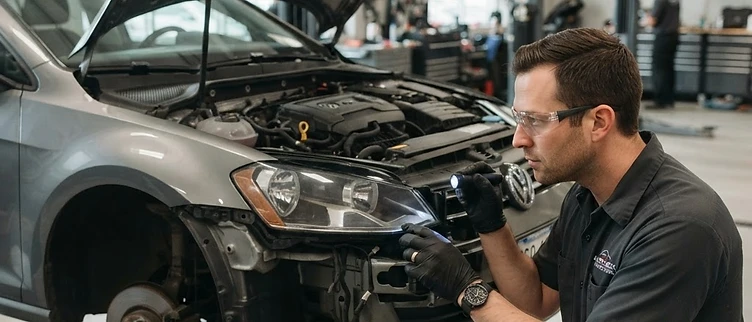
You're looking for signs that repairs may not have been completed particularly well.
Pay attention to:
Uneven panel gaps
Paint that doesn't quite match
Overspray
Bumpers that don't line up properly
Doors that don't close normally
Hood or trunk alignment
Missing clips or trim
Waves or imperfections in body panels
Uneven gaps around headlights and taillights
None of these automatically proves the vehicle is unsafe.
But they can tell you that more investigation is needed.
And don't inspect a car like you're trying to catch it committing a crime.
Used vehicles aren't perfect.
You're looking for evidence that helps you understand what you're buying.
Paintwork Isn't Automatically Bad
This deserves its own section.
Sometimes shoppers hear:
"That panel has been painted."
and immediately assume the car is ruined.
Not necessarily.
Paint work could result from:
Collision repair
Scratches
Hail damage
Vandalism
Cosmetic repair
The fact that a panel was repainted matters.
But the quality and reason for the repair matter more.
A professionally repaired and refinished panel isn't the same thing as a bad repair.
Again:
Context.
Structural Damage Deserves More Attention
This is where I'd become considerably more cautious.
Modern vehicles are designed with structural components that play an important role in crash protection.
If a vehicle suffered significant structural damage, I want to know that it was repaired correctly.
This is exactly the kind of situation where an independent pre-purchase inspection becomes especially valuable.
A qualified technician or collision-repair professional may be able to identify evidence of:
Previous structural repair
Welding
Pulling or straightening
Improper repairs
Suspension damage
Alignment problems
Underbody damage
I'm not saying every previously damaged vehicle with structural repairs should automatically be rejected.
I'm saying the burden of proof gets higher.
Check the Title
An accident history and a branded title are not the same thing.
A vehicle can have a previous accident and still have a normal title.
A vehicle that was declared a total loss may have a different title history depending on what happened afterward and applicable state requirements.
That's an important distinction.
If you're looking at a vehicle with a salvage, rebuilt or other branded title, don't treat it like a normal accident-history vehicle.
You need to understand exactly what that title brand means before buying.
That can affect:
Financing
Insurance
Resale value
Future trade value
If you're not sure what you're looking at, stop and get clarification before moving forward.
Pay Attention to Airbag Deployment
If the history indicates airbags deployed, I'd want to know considerably more about the accident and repair.
Airbags deploy during more significant collision events, and replacing the visible airbag isn't necessarily the only repair involved.
Depending on the accident, there may have been work involving:
Sensors
Seat belt components
Interior panels
Steering wheel components
Dashboard components
Structural areas
That doesn't automatically make the vehicle a bad purchase.
But it's not something I'd shrug off.
Test Drive It
This is important for every used car.
It's even more important when you're evaluating one with previous accident damage.
Don't just drive around the block.
Pay attention to how the vehicle behaves at different speeds.
Does it:
Track straight?
Pull to one side?
Vibrate?
Make unusual noises?
Have steering that feels normal?
Brake straight?
Have excessive wind noise?
Have warning lights?
Feel unstable over bumps?
Turn the radio off for part of the drive.
Yes, I know.
You'll survive for ten minutes.
Listen to the car.
Check the Tires
Tires can tell you things.
Look for:
Uneven wear
Different tread depths
Mismatched tires
Abnormal wear on one corner
Signs of alignment problems
Uneven tire wear doesn't automatically mean the previous accident caused it.
Cars can need alignments for plenty of reasons.
But if you're already investigating previous collision damage, unusual tire wear is another clue worth understanding.
Get a Pre-Purchase Inspection
If I were buying a vehicle with a meaningful accident history, this would be high on my list.
Have an independent qualified mechanic inspect the car.
Tell them about the accident history.
Don't just say:
"Can you look this over?"
Say:
"This vehicle has a previous accident on the history report. I'd specifically like you to look for evidence of poor collision repair, suspension issues, alignment concerns or other problems related to previous damage."
Give them context.
If the accident involved significant body or structural work, an inspection from someone experienced in collision repair may also be useful.
A couple hundred dollars spent learning about a vehicle before you buy it can be considerably cheaper than learning about it afterward.
Does an Accident Lower the Value?
It can.
Two otherwise identical used vehicles may not have the same market value if one has a significant accident history and the other doesn't.
But there isn't a universal formula like:
One accident = vehicle is worth exactly $3,742 less.
It depends on:
Severity
Repair quality
Vehicle age
Mileage
Market demand
Title status
Documentation
Current condition
A minor accident on a ten-year-old vehicle may matter differently than significant collision damage on a nearly new one.
That's why the price needs to make sense for the specific vehicle you're buying.
Don't Overpay Just Because the Repair Looks Good
Let's say you're comparing two similar cars.
Vehicle A
$25,000
No reported accidents
Vehicle B
$24,800
Previous significant accident
Assuming everything else is similar, saving $200 probably isn't enough to make me excited about taking on the additional history.
Now imagine Vehicle B is:
$21,500
And you've verified the repairs, had it inspected, it drives properly and you're comfortable with the history.
That's a much more interesting comparison.
I'm not saying $3,500 is automatically the correct discount.
I'm saying price is part of the risk calculation.
If you're accepting something that may hurt future resale value, I'd want the purchase price to make sense today.
Think About Future Resale
You may be comfortable with the accident history.
The person buying it from you someday may not be.
That's important.
If you trade or sell the vehicle later, the same history report may appear for the next buyer.
That could affect:
Trade value
Private-party value
Number of interested buyers
This doesn't mean you shouldn't buy it.
It means you should account for that when you buy it.
If you receive an appropriate value because of the history, then accepting a lower value later isn't necessarily disastrous.
The mistake would be paying clean-history money for a vehicle whose history may reduce its value later.
What About a Really Cheap Accident Car?
Cheap isn't enough.
A vehicle can be discounted for a very good reason.
Suppose a comparable clean-history vehicle costs:
$28,000
and you find one with previous significant damage for:
$21,000.
That's a $7,000 difference.
Interesting?
Absolutely.
Automatic bargain?
Nope.
Before getting excited about the savings, figure out:
Why is it $7,000 cheaper?
If it's been properly repaired, passes inspection and the title/history make sense, maybe you've found an opportunity.
If it's cheap because the repair quality is terrible, you haven't saved $7,000.
You've purchased a problem at a discount.
When I'd Consider Buying One
I'd be comfortable considering a previous-accident vehicle when:
I understand what happened
The title situation is clear
The repairs appear professional
The vehicle drives correctly
An inspection doesn't reveal major concerns
Maintenance history is good
The price appropriately reflects the vehicle's history
I'm comfortable with the potential effect on future resale
Notice the wording:
Consider.
Not automatically buy.
The accident is one factor in the decision.
When I'd Probably Walk Away
I'd become much less interested if:
Nobody can explain significant previous damage
The title history raises concerns
Repairs appear poorly performed
Panel gaps are obviously wrong
Paintwork is poor
Warning lights are present
The vehicle doesn't track straight
Tires show strange wear
There are obvious signs of structural problems
The seller won't allow an independent inspection
The price is basically the same as a comparable clean-history vehicle
There are too many used cars in the world to convince yourself to buy one you're uncomfortable with.
Don't Forget the Rest of the Car
This sounds obvious, but accident history can become such a big focus that shoppers forget everything else.
You still need to evaluate:
Maintenance
Mileage
Tires
Brakes
Engine
Transmission
Interior condition
Features
Price
Ownership history
Imagine Vehicle A has one properly repaired minor accident and excellent maintenance records.
Vehicle B has no reported accidents but terrible maintenance, worn-out tires and several mechanical problems.
Which one would you rather own?
Exactly.
Don't buy the history report. Buy the car.
Questions I'd Ask Before Buying
If you're looking at a used vehicle with an accident in its history, ask:
How severe was the accident?
Where was the vehicle damaged?
Were the airbags deployed?
Was there structural damage?
Who performed the repairs?
Are repair records available?
Does the vehicle have a normal or branded title?
Can I have it independently inspected?
How does the price compare with similar vehicles without accident history?
You may not get perfect answers to every question.
But the answers you do get help you understand the risk.
Bottom Line
An accident on a vehicle history report is not automatically a reason to walk away.
It's a reason to investigate.
There's a massive difference between minor cosmetic damage and a serious collision.
Find out what happened.
Look at the quality of the repair.
Check the title.
Drive the vehicle.
Have it inspected when appropriate.
And make sure the price reflects what you're actually buying.
I'd rather own a properly repaired vehicle with one accident in its history than a neglected vehicle with a perfectly clean history report.
The report is a tool.
The actual car is what you're buying.
If you've found a used car with an accident on the history report and aren't sure whether you should consider it, Send Me a Car. Send me the listing and I'll help you figure out what questions you should be asking before you buy it.
Frequently asked
Should I immediately skip a car with an accident on its history report?
Not necessarily; minor cosmetic repairs are very different from significant structural damage. Use the report as a starting point for your investigation, not as an automatic disqualifier.
How can I verify if an accident was repaired correctly?
Ask the seller for repair invoices, look for uneven body gaps or mismatched paint, and most importantly, pay a trusted local mechanic for a pre-purchase inspection.
Does a previous accident hurt the future resale value?
Yes, it often does. When buying, ensure the purchase price reflects this history so you aren't surprised by a lower trade-in offer when you eventually sell the vehicle.
What if the car has a salvage or branded title?
Branded titles indicate major damage or total loss status, which can make financing and insurance difficult. Be extra cautious and fully understand the title status before proceeding.
AW
Andrew Woods
Car salesperson in Wichita, Kansas. I built this resource to help local buyers make confident decisions.