Trade-ins· Preparation
Should You Fix Your Car Before Trading It In?
Wondering if you should repair your car before trading it in at a Wichita dealership? Usually, the answer is no, but it depends on the math.
Andrew Woods September 23, 2026
Wondering if you should repair your car before trading it in at a Wichita dealership? Usually, the answer is no, but it depends on the math.
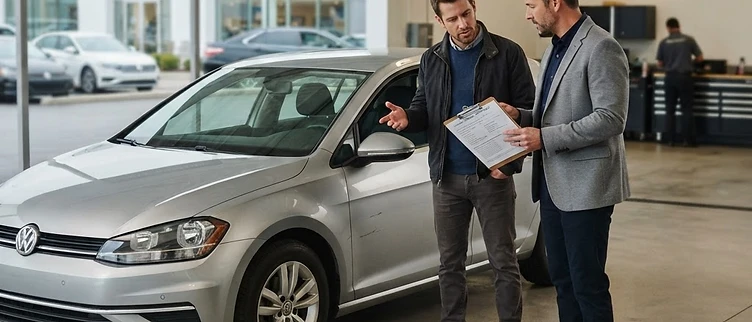
You've decided it's probably time to trade your car.
There's just one problem.
Actually, there are four.
The check-engine light is on.
There's a dent in the passenger door.
The tires are getting low.
And the air conditioning makes a noise that you're pretty sure wasn't included from the factory.
So now you're wondering:
Should I fix all of this before I trade it in?
Usually?
Not everything.
Sometimes making a small repair before trading can make sense. But spending thousands of dollars trying to turn your current vehicle into the world's nicest trade-in can easily cost you more than you get back.
You usually don't need to fix every problem with your car before trading it in.
I'd consider fixing inexpensive problems that noticeably improve the vehicle's condition or presentation.
I'd be much more cautious about paying for:
The real question isn't:
"Will fixing this increase my trade value?"
It's:
"Will fixing this increase my trade value by MORE than the repair costs me?"
That's the math that matters.
This is probably the biggest misconception.
Let's say your car needs $1,500 worth of repairs.
You think:
If I spend $1,500 fixing it, surely it'll be worth at least $1,500 more.
Maybe.
But probably not automatically.
Suppose your vehicle is currently worth approximately:
$10,000 as it sits.
You spend:
$1,500 repairing it.
The dealership then values it at:
$10,800.
Congratulations.
You spent $1,500 to gain $800.
You essentially lit $700 on fire, but at least the check-engine light isn't on anymore.
That's why I generally want to know what the vehicle is worth before making a major repair.
If you're considering spending serious money on your current vehicle specifically because you plan to trade it, I'd try this first:
Have the vehicle appraised as-is.
Find out what somebody is actually willing to give you for it.
Then you have a baseline.
Maybe you thought that dent was destroying the value.
The dealership might tell you it barely changes the appraisal.
Maybe you were about to spend $900 replacing the tires.
The dealership might prefer to handle them itself.
Or maybe there's a mechanical problem that's significantly hurting the value and repairing it really would make sense.
You can't make that calculation until you have numbers.
This is another important piece.
Let's say your car needs body work.
You take it to a retail body shop and receive a quote for:
$1,800.
You assume the dealership will deduct $1,800 from your trade value.
Not necessarily.
A dealership may have:
The same applies to tires, brakes, cosmetic repairs and other reconditioning.
That doesn't mean the dealership can repair everything for six dollars and a firm handshake.
It means your retail repair cost and the dealership's cost aren't necessarily the same.
That's why fixing everything before getting an appraisal can be a mistake.
This one depends entirely on why it's on.
A check-engine light could represent something relatively inexpensive.
Or it could represent a much larger problem.
If the light is on, I'd at least want to know why.
Get the vehicle properly diagnosed.
Then you can compare the repair cost with the potential effect on your trade value.
Imagine the diagnosis is:
$180 repair.
If fixing it removes a warning light from the dashboard and makes the vehicle considerably easier to evaluate, that could make sense.
Now imagine the diagnosis is:
$4,500 repair.
That's a very different conversation.
Don't spend $4,500 automatically because you're afraid nobody will take the car on trade.
Dealerships take vehicles needing repairs all the time.
The problem will affect the value.
That doesn't necessarily mean you should be the one to repair it.
Usually, I wouldn't automatically put a brand-new set of tires on a car I'm about to trade.
Tires aren't cheap.
Suppose your vehicle needs four tires and replacing them costs:
$900.
Will your trade value increase by the full $900?
Maybe not.
If the tires are completely worn out, damaged or unsafe, they will affect the appraisal.
But that doesn't mean buying premium replacement tires before trading is the best use of your money.
Get the vehicle appraised first.
If you're trading the car next week, spending $900 on tires so somebody else can enjoy them for the next 40,000 miles isn't automatically a brilliant financial strategy.
Same basic idea.
If your brakes need replacement, that's part of the vehicle's condition.
But don't assume you need to spend $700 or $1,000 on a complete brake job before a dealership will accept the car.
Have the vehicle appraised.
Find out how the condition affects the number.
Then compare that against the repair cost.
If the repair costs you $800 and only improves the trade value by roughly $400, you have your answer.
Small cosmetic issues are usually where people overthink things.
Used cars have scratches.
They get door dings.
Wheels get curb rash.
Bumpers get scuffed.
If you're trading a seven-year-old vehicle with 90,000 miles, nobody evaluating it expects it to have been preserved in a climate-controlled museum.
Condition matters, but normal wear is normal.
I wouldn't automatically pay a body shop to fix every imperfection.
There are exceptions.
If you have a significant dent that can be repaired inexpensively with paintless dent repair, for example, the numbers might make sense.
But again:
Repair cost vs. increase in value.
That's the test.
This one is worth evaluating.
A cracked windshield is an obvious problem, and depending on the vehicle, replacing a modern windshield can be more complicated than people expect.
Some vehicles have cameras or sensors mounted around the windshield that may require calibration after replacement.
Before paying for it yourself, I'd check:
If your insurance coverage makes replacement inexpensive, fixing it may be worthwhile.
If you're paying a substantial amount out of pocket immediately before trading, I'd want to see the math first.
Let's say your vehicle is due for:
You're planning to trade it this month.
Do you need to perform all of it first?
I wouldn't automatically do major scheduled maintenance solely for the next owner.
If you're still driving the vehicle, you should obviously keep it safe and properly maintained.
But there's a difference between:
Maintaining the vehicle you own
and
Spending $1,200 immediately before trading it because you're hoping to recover $1,200 in value.
You may not.
If you've already completed major maintenance recently, though, bring the records.
That can help demonstrate how the vehicle has been cared for.
Now we're talking about something I'd be more willing to do.
But you probably don't need the $400 deluxe detail package involving seventeen ceramic coatings and someone cleaning the air vents with laboratory equipment.
Just make the car presentable.
I'd recommend:
You're not trying to fool anybody into thinking the vehicle is better than it is.
You're making it easier to see its actual condition.
A vehicle buried under fast-food wrappers, gym clothes and six months of receipts doesn't exactly scream:
"I have lovingly maintained this automobile."
Cleaning your vehicle doesn't magically change its year, mileage or mechanical condition.
But presentation can help.
More importantly, cleaning the car allows the person appraising it to properly inspect it.
You don't need to spend a fortune.
A Saturday morning and a vacuum cleaner will accomplish a lot.
This should go without saying, but let's say it anyway.
Don't clear warning lights and hope they stay off long enough to trade the vehicle.
Don't pour some mystery liquid into the engine to temporarily hide a problem.
Don't intentionally conceal damage.
Dealerships evaluate used vehicles every day.
They're looking at:
Just be straightforward.
If you know something is wrong, say so.
Let's say your transmission is failing.
The repair estimate is:
$6,000.
And the vehicle might only be worth $10,000 or $12,000 in good condition.
This is exactly when I'd want an as-is trade appraisal before authorizing the repair.
Maybe fixing it makes sense.
Maybe trading it as-is makes more sense.
Maybe keeping it makes more sense.
You need to compare:
Current trade value as-is
against
Expected trade value after repair minus the repair cost.
Here's an example.
Trade value:
$6,500
You spend:
$0
Net value:
$6,500
Repair:
$6,000
Trade value afterward:
$11,000
Effective value after repair cost:
$5,000
In that example, repairing the vehicle before trading actually leaves you $1,500 worse off.
Obviously, real appraisals and repair estimates will vary.
But that's exactly why you run the numbers before making the repair.
Now the equation can change.
A private buyer may be much less interested in purchasing a vehicle that immediately needs tires, brakes or mechanical repairs.
Fixing certain problems could make the vehicle easier to sell privately.
You might also receive a higher selling price.
But you'll need to decide whether that higher price justifies:
This is one reason the answer can be different when you're selling privately versus trading to a dealership.
I'd be most interested in inexpensive problems that have an outsized effect on the vehicle's presentation or usability.
Things like:
If it costs $30 and takes 10 minutes, sure.
If somebody hands you a $3,800 estimate?
Get an appraisal first.
Before spending significant money, I'd pause on:
I'm not saying never fix these.
I'm saying:
Know the numbers first.
If you have them, bring useful information about the vehicle.
That can include:
If you just spent $2,000 maintaining the vehicle, don't make the appraiser guess.
Show them.
It doesn't guarantee you'll get every dollar back.
But documented maintenance is useful information when evaluating a used vehicle.
Sometimes people start fixing their car because they've already decided they need a new one.
But maybe that's worth reconsidering too.
Suppose your car is paid off and needs a $1,500 repair.
That's annoying.
But replacing it might mean:
$35,000 vehicle
plus
taxes and fees
plus
interest
plus
a monthly payment for the next several years.
Suddenly that $1,500 repair doesn't look quite as horrifying.
If you otherwise like the car and it's still reliable, repairing it and keeping it may be the smarter financial move.
You don't need to trade your vehicle just because it needs something.
Cars require repairs.
That's part of owning them.
You don't need to make your car perfect before trading it in.
Before spending serious money on repairs, find out what the vehicle is worth in its current condition.
Then do the math.
If spending $300 could realistically improve your situation by $700, great.
If spending $2,000 might only improve your trade value by $1,000, keep your money.
Dealerships expect used vehicles to need reconditioning.
They can take vehicles with dents.
They can take vehicles needing tires.
They can take vehicles with mechanical problems.
Those issues will affect what the car is worth, but you don't necessarily need to solve every one of them yourself.
And sometimes the smartest move isn't fixing the car or trading it.
It's keeping it.
If you're thinking about trading your vehicle and aren't sure whether it's worth repairing something first, Ask Andrew. Tell me what's wrong with it, what you've been quoted for the repair and what you're considering replacing it with, and I'll help you think through the numbers.
Not necessarily. Often, the cost of a major repair will be higher than the actual increase in your vehicle's trade-in value.
While it won't change the car's mechanical state, a clean car is easier to inspect and shows the dealer you've maintained it well.
Usually, no. Dealerships have wholesale tire pricing and can often handle replacements much cheaper than you can at a retail shop.
Get it diagnosed first to see if it is a minor, inexpensive fix or a major problem, then weigh that cost against the potential appraisal impact.
Andrew Woods
Car salesperson in Wichita, Kansas. I built this resource to help local buyers make confident decisions.