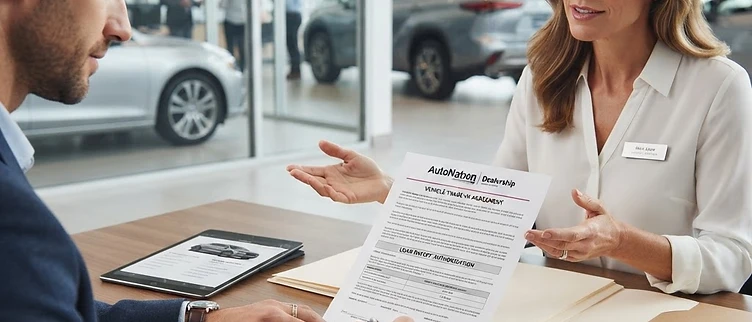
What Happens to Your Old Car Loan When You Trade It In?
Trading in a car with an active loan is common in Wichita. We explain how payoffs work and what happens to your equity, whether you are ahead or behind on your payments.
Andrew Woods September 5, 2026
If you still owe money on your current vehicle, you can potentially trade it in before the loan is paid off.
People do it all the time.
But that creates an obvious question:
What happens to your old car loan when you trade the vehicle?
The short answer is:
Your old loan has to be paid off as part of the trade-in transaction.
The dealership typically obtains the payoff amount from your lender and sends the required payoff to satisfy the old loan.
But what happens financially depends on the relationship between two numbers:
What your vehicle is worth
and
what you still owe.
If your car is worth more than your payoff, you have positive equity.
If it's worth less than your payoff, you have negative equity.
And that difference can have a major impact on your next purchase.
Let's walk through exactly how it works.
Can You Trade In a Car You Still Owe Money On?
Yes.
You generally do not have to completely pay off your current vehicle before trading it.
Suppose you purchased a vehicle three years ago with a six-year loan.
You still have three years of payments remaining.
You can potentially trade that vehicle today.
The remaining loan simply needs to be addressed as part of the transaction.
What Is a Loan Payoff?
Your loan payoff is the amount required to completely satisfy your current auto loan as of a specific date.
This isn't always exactly the same as the balance you see on your most recent statement.
Interest can continue accruing, and the payoff may include other amounts depending on the loan.
That's why a dealership will typically obtain a current payoff when you're trading a financed vehicle.
For example:
Your account might show a balance around:
$21,900
while the actual payoff might be:
$22,050.
If you're seriously considering trading, use the payoff—not an old statement balance.
Who Pays Off the Old Car Loan?
When you trade a financed vehicle as part of a purchase, the dealership generally handles sending the required payoff to your existing lender.
Let's say your payoff is:
$20,000.
The dealership doesn't simply hand you $20,000 and hope you remember to pay your bank.
The payoff is handled as part of the transaction so the existing lien can be satisfied.
That's what allows the ownership/title process to move forward.
Does the Dealership Take Over Your Loan?
No.
This is an important distinction.
The dealership isn't normally taking over your monthly payments or continuing your existing loan.
The old loan is being paid off.
If you're financing your next vehicle, you'll have a new loan associated with the new transaction.
Think of them as two separate loans:
Old vehicle → Old loan gets satisfied
New vehicle → New financing begins
The equity or negative equity from the old vehicle can affect the new transaction, but the actual loans are separate.
What Happens If Your Car Is Worth More Than You Owe?
This is the easiest scenario.
Suppose:
Trade value: $25,000
Loan payoff: $18,000
Subtract:
$25,000 − $18,000 = $7,000
You have approximately:
$7,000 in positive equity.
That equity can generally be applied toward your next purchase.
For example:
New vehicle:
$35,000
Positive trade equity:
$7,000
Ignoring taxes, fees, optional products, and other transaction details for simplicity, your equity effectively reduces the amount that needs to be covered on the next vehicle.
Positive equity works a lot like having money available toward the transaction.
What Happens If Your Car Is Worth Exactly What You Owe?
Suppose:
Trade value: $20,000
Payoff: $20,000
You're approximately:
even.
The trade value covers the old loan payoff.
You don't have meaningful positive equity to apply toward the next purchase.
But you also don't have negative equity that needs to be addressed.
It's basically a clean break from the old loan.
What Happens If You Owe More Than the Car Is Worth?
Now we get into negative equity.
Suppose:
Trade value: $20,000
Loan payoff: $25,000
You're approximately:
$5,000 upside down.
The dealership still needs to send the lender the full payoff required to satisfy the old loan.
But the vehicle itself only provided $20,000 of value.
That leaves:
$5,000
that still needs to be accounted for.
The debt does not disappear because you traded the vehicle.
Where Does the Negative Equity Go?
Depending on the transaction and lender approval, you may be able to:
Pay the difference in cash
Pay part of the difference in cash
Potentially include some or all of the negative equity in the new financing
Wait and continue paying down your current vehicle instead of trading
Let's say you're:
$5,000 upside down
and the lender approves a transaction that includes that amount in the new financing.
You're effectively bringing approximately $5,000 of old debt into the next transaction.
That's why it's often called:
“rolling negative equity into the new loan.”
Example of Rolling an Old Loan Into a New Transaction
Suppose you're buying a vehicle for:
$30,000.
Your trade is worth:
$18,000.
Your payoff is:
$23,000.
Negative equity:
$5,000
In a simplified example:
$30,000 new vehicle
plus
$5,000 negative equity
=
$35,000
that needs to be accounted for before taxes, fees, optional products, down payment, incentives, or other transaction details.
That's why someone can buy a $30,000 vehicle but end up financing considerably more than $30,000.
Part of the new loan may effectively be paying off debt from the old vehicle.
Does the Dealership “Pay Off” Your Trade?
Yes—but be careful about what that phrase means.
You'll sometimes see advertisements saying:
“We'll pay off your trade no matter what you owe!”
Your old lender does need to receive the required payoff.
But that does not mean negative equity magically disappears.
Suppose:
Trade value: $15,000
Payoff: $24,000
That's:
$9,000 negative equity.
If a dealership pays the lender $24,000 to satisfy the old loan, the $9,000 difference still has to be accounted for somewhere.
Always look at:
Trade value
Loan payoff
Equity
instead of relying on advertising language.
How Long Does It Take for the Old Loan to Be Paid Off?
It usually isn't instantaneous.
There can be processing time between:
Trading the vehicle
and
the old lender receiving and posting the payoff.
The exact timing varies by dealership, lender, weekends, holidays, title requirements, and other factors.
So don't panic if you trade your vehicle on Saturday and your old lender's app still shows a balance on Monday morning.
But you should keep an eye on the account until the payoff is completed.
Should You Keep Making Payments After Trading the Car?
Don't simply assume you're done with the old lender the moment you hand over the keys.
If a payment comes due before the payoff has been processed, contact the lender and/or dealership and confirm what you should do.
You don't want to accidentally create a late payment because you assumed the loan had already been closed.
Until you can verify the old loan has been satisfied, pay attention to the account.
What If You Already Made a Payment After Trading?
Depending on timing, the payoff amount sent to your lender and the final loan balance may need to be reconciled.
If the lender receives more than what is ultimately required to satisfy the loan, any applicable overpayment is generally handled according to the lender's process.
If this happens, contact your lender and ask how the account will be settled.
Don't assume the dealership keeps an extra loan payment you made directly to your lender.
What Happens to Automatic Payments?
This is something people forget.
If you have autopay set up on your old loan, don't immediately start changing things without knowing where the payoff stands.
First verify that the loan has actually been satisfied.
Then make sure future automatic payments are no longer scheduled.
The goal is to avoid both:
Missing a payment before payoff
and
unnecessarily sending payments after payoff.
What Happens to Your Title?
If your vehicle has a lien, the lender has a legal interest in the vehicle until the loan is satisfied.
When the dealership pays off the loan, the lien-release/title process follows according to the lender and applicable state procedures.
As the customer, you typically don't need to personally receive a clear title first and then return to the dealership to complete the trade.
The payoff and title process can generally be handled as part of the transaction.
Exact procedures can vary by state and lender.
What If You Don't Know Who Your Lender Is?
It happens more than you'd think.
Maybe the loan was set up several years ago.
Maybe your account was transferred.
Maybe you simply don't remember.
Look at:
Your bank statements
Your credit report
Your auto-loan statements
Your lender's online account
Your original purchase paperwork
The dealership will need accurate lender information to obtain the payoff.
What Information Does the Dealership Need?
For a financed trade, you'll typically want to have information such as:
Lender name
Account information if requested
Current payoff if available
Vehicle registration
Identification
Any required title documentation
Both keys if you have them
Requirements can vary, so ask before arriving if you want to make the process easier.
What If Your Loan Is Through a Credit Union?
Same basic idea.
Whether your vehicle is financed through:
A bank
Credit union
Manufacturer finance company
Other auto lender
the loan needs to be satisfied when the vehicle is traded.
The exact payoff and title-release process can vary by lender.
Some local lenders may handle things differently from large national finance companies.
That's normal.
What If You Have a Very Low Interest Rate on Your Current Loan?
This is worth thinking about before trading.
Suppose your current loan is:
2.9% APR
and replacing the vehicle would require financing at:
7% APR.
Even if you're not upside down, you're giving up relatively inexpensive financing and replacing it with more expensive financing.
That doesn't automatically mean you shouldn't trade.
Maybe you genuinely need a different vehicle.
But the current loan should be part of your decision.
Don't evaluate your trade solely based on:
“Can I get out of my current payment?”
Look at what you're replacing it with.
What If Your Current Payment Is Higher Than the New Payment?
Be careful here.
Suppose your old payment is:
$650/month
and the new vehicle payment is:
$550/month.
It might feel like you're saving $100 per month.
But ask:
How many payments did I have left on the old loan?
How many payments am I starting over with?
If you had 24 payments remaining and you're replacing them with 72 new payments, the lower payment doesn't necessarily mean you're spending less money.
You reset the clock.
This doesn't automatically make the trade bad.
It just means the monthly payment isn't enough information to judge the decision.
Can You Trade a Car Before the First Payment?
Potentially.
But this can create a difficult financial situation.
Very early in a loan, you may owe substantially more than the vehicle's current trade value.
Your amount financed may have included:
Taxes
Fees
Optional products
Previous negative equity
while the vehicle itself may have already depreciated.
So yes, it may be possible to trade very quickly.
But you should find out your actual payoff and trade value before assuming the numbers will work.
Can You Trade a Car After Only One Year?
Yes.
There's no universal rule saying you have to keep a financed vehicle for a certain number of years before trading.
The question isn't:
“Am I allowed to trade?”
It's:
“What is my equity position?”
If your vehicle is worth:
$28,000
and your payoff is:
$27,000
you're in a very different situation from someone whose vehicle is worth:
$28,000
and payoff is:
$38,000.
How long you've owned the vehicle matters less than the actual numbers.
What If You're $10,000 Upside Down?
This is where I'd slow down and look carefully at the situation.
Suppose:
Trade value: $25,000
Payoff: $35,000
You're approximately:
$10,000 upside down.
Can you potentially trade?
Maybe.
But you shouldn't automatically assume a lender will allow the entire $10,000 to be included in another loan.
Lenders may consider:
Credit
Income
Existing debt
New vehicle
Vehicle value
Amount financed
Loan term
Down payment
Loan-to-value
Sometimes the answer is:
More money down.
Sometimes:
A different vehicle.
And sometimes:
Keep the current vehicle and pay it down.
That last answer isn't exciting, but it may be the smartest one.
How Do You Know If Trading Makes Sense?
Start with these numbers:
1. Current Trade Value
What will someone realistically pay for the vehicle?
2. Current Loan Payoff
What does it take to completely satisfy the loan?
3. Equity
Calculate:
Trade Value − Payoff = Equity
4. New Vehicle Price
What are you buying?
5. New Amount Financed
How much debt are you actually taking on?
6. New APR and Term
What's the cost and length of the new financing?
Now you can compare your current situation with the new one.
Should You Pay Off Your Car Before Trading It?
You don't necessarily need to.
If you're planning to trade soon, paying the loan completely off first may simply add another step.
The dealership can generally handle the existing payoff as part of the transaction.
However, making additional principal payments beforehand could improve your equity position.
Whether that's worthwhile depends on your situation.
Should You Put Money Down If You're Upside Down?
Cash down can help offset negative equity.
For example:
Negative equity: $6,000
Cash down: $4,000
That could effectively reduce the remaining difference to approximately:
$2,000
before considering the rest of the transaction.
That may improve the overall financing structure.
But don't automatically empty your savings just to trade vehicles.
If you need $10,000 out of your emergency fund just to escape a perfectly functional vehicle, I'd seriously ask whether trading right now is necessary.
What If You Have Positive Equity?
That's a much nicer problem.
Suppose:
Trade value: $30,000
Payoff: $20,000
You have approximately:
$10,000 positive equity.
That equity can generally be applied toward the next transaction, reducing the amount you need to finance.
You may also choose to structure the transaction differently depending on your circumstances.
The important thing is knowing the equity exists.
How Does a Trade Affect Kansas Sales Tax?
For a qualifying vehicle transaction in Kansas, the trade-in allowance can generally reduce the amount of the purchase subject to sales tax.
That's separate from your loan payoff.
This distinction is important.
Suppose:
Trade value: $20,000
Loan payoff: $15,000
Your positive equity is:
$5,000.
But your trade allowance may still have a different role in determining the taxable transaction under applicable Kansas rules.
Don't confuse:
Trade value
with
trade equity.
They're different numbers.
Actual Kansas tax treatment depends on the specific transaction and current law.
The Three Numbers You Need to Know
If you remember nothing else from this article, remember these:
Trade Value
What your vehicle is worth.
Payoff
What you owe the lender.
Equity
The difference between the two.
The formula:
Trade Value − Payoff = Equity
Example:
Trade value: $24,000
Payoff: $19,000
=
$5,000 positive equity
Or:
Trade value: $24,000
Payoff: $29,000
=
$5,000 negative equity
Once you understand those three numbers, the entire trade-in process makes a lot more sense.
The Bottom Line
When you trade a vehicle you still owe money on, your old loan doesn't simply disappear.
It gets paid off as part of the transaction.
If your vehicle is worth more than your payoff, you have positive equity that can generally help with your next purchase.
If your vehicle is worth less than your payoff, you have negative equity that has to be accounted for.
You may potentially be able to include some negative equity in the next financing if the lender approves it.
Or you might cover the difference with cash.
Or the smartest move may be keeping your current vehicle and paying it down longer.
The important thing is knowing where you stand before you start trying to structure the next deal.
Find Out Where Your Current Loan Stands
If you already know your:
Trade value
and
current payoff
use the Trade Equity Calculator to estimate your positive or negative equity.
This article is for general educational purposes. Loan payoffs, trade values, lender requirements, title procedures, financing approvals, loan-to-value limits, taxes, and transaction structures vary by lender, vehicle, borrower, location, and transaction. Kansas tax and title rules may change. This article is not financial, tax, or legal advice and is not an offer or guarantee of financing.
Frequently asked
Can I trade in my car if I still owe money on it?
Yes, you can trade in a vehicle before the loan is fully paid off. The dealer will coordinate the payoff with your lender as part of the trade-in transaction.
What is negative equity, and how does it affect my trade?
Negative equity occurs when you owe more on your loan than your car is currently worth. You may need to pay the difference in cash or roll that balance into your new loan.
Should I keep making payments after I trade in my car?
Yes, continue making payments until you receive written confirmation from your lender that the loan has been fully satisfied to avoid late fees or credit issues.
Do I need to get my own loan payoff amount before visiting a Wichita dealer?
It is helpful to have, but the dealership will typically request a formal 10-day payoff directly from your lender to ensure accuracy.
AW
Andrew Woods
Car salesperson in Wichita, Kansas. I built this resource to help local buyers make confident decisions.